
Plosives & Posterity
The Courage of a Creative

Dear Reader,
I’ve been thinking about posterity a lot recently. If you follow me on Instagram, I’m reflecting on previous seasons in my life, this month. Something about October is ripe for nostalgia; looking back and seeing how far we’ve come. This has led me to meditate on a few bigger life questions:
What holds us back from our full creative potential? Why don’t we stretch ourselves to take our fullest creative risks?
Well, in my case, it has my creative Achilles heel: TYPOS.
I work very hard to find them, catch them, and burn them from existence, but I wasn’t born with The Elements of Style (E. B. White & William Strunk Jr.) burned into my hard drive. The reason: when I’m writing creatively, I’m working in the right side of the brain. The left side is order, logic, math, science, admin, and analysis. The right side is feelings, emotions, visuals, the things that are hard to articulate. When I put creative work into words, typing goes out the window, and it has to. If I’m focused on the spelling, I’m not fully present to the worlds I’m creating, the emotions I’m capturing, and the story I’m cultivating. All I can do is let the work flow, and go back later, praying that I catch all the misspellings.
I used to be quite embarrassed about this. I took a class on the “History & Structure of the English Language” at Harvard to help correct it. I really did not want to, but my mother said, “You’re a writer, Shayla, you’ve got to get this figured out.” She is 100% right, but unfortunately, Harvard’s “History & Structure of the English Language” only made matters worse. Why, you ask. I’ll tell you.
This was one of the hardest classes I took at Harvard, and it was taught by Professor Daniel Donoghue, who trained under another professor, who studied under Professor J.R.R. Tolkien. Yes, that’s right, thanks to this class, I am officially the academic great-granddaughter of J.R.R. Tolkien, the philologist. (Thanks, Mom. Seriously). And here’s what I learned:
Language is invented.
Spelling is a social agreement.
Until the publication of the English Standard Dictionary in 1755, spelling was fluid, sounded out. You would find multiple spellings of the same word, and all were totally accepted.
You grammar Nazi’s out there might say to me, “Well, it’s not fluid anymore! We nailed that down with the dictionary and The Elements of Style.”
True, but language is still being invented today. New words come up every year, because language is simply a matter of social contract: do enough people agree that this word means thus and such and is spelled XYZ way? This is why ‘colour’ and ‘color’ are both valid spellings, and the letter arrangement ‘ough,’ has a ridiculous number of correct pronunciations.
In this class, I learned the group names for all the sounds based on their physical creation within the mouth. We’ve got plosives and fricatives, and phonological changes of word pronunciation over time. The final project in this class was inventing a new language based on the English language and the phonological slides that might occur due to external influences. Using the tools and terms I learned in the class, I did this and then had to write out sentences in the new language AND record myself speaking it. Tolkien would have been proud.
Though the construction of the language was somewhat scientific, fluid pronunciation was more of a responsive and artistic endeavor. It sounded like gibberish, but when you paid attention to the text and the systematic changes, it made perfect sense.
Again, this was one of my hardest classes. I got an A. Why? Because the creation of a new language is more about emotional honesty than fixed spellings. Thus, taking “The History & Structure of the English Language” made my spelling even worse, because it put me more in touch with the sounds behind each word, and their potential spelling, and the truth that all spelling is invented, a social contract we enter into.
Do I believe in correct spelling and grammar? Yes. Bad spelling and grammar are evidence of lazy writing, and cause all of us (I believe) to take a writer less seriously. For this reason, publishing my own work each month is an act of nail-biting bravery for me. I’ll admit, each time I press “publish,” I feel like I’m closing my eyes and jumping off a cliff into dark water that, hypothetically, has no boulders just beneath the surface.
When we perform a creative act and make it public to the world, we want it to be perfect. Unfortunately, many artists, myself included, struggle with perfectionism. But the only way to move forward is by not letting perfection stand in the way of progress. Excellence comes from moving forward, getting into it, making mistakes, learning from them, and getting better.
I have several pieces of fictional work finished and ready to go for audiences, but I was dragging my feet publishing them in a bound, tangible format for the public. Why? Because of typos. I was scared, not just of typos, but of whether or not my work was good enough. Would I be embarrassed, would people judge me, and any unconscious world views I have that are displayed in my storytelling, or mistakenly assume that I am my characters? Certainly, an author puts him or herself into each of the characters, but the work of a professional is to serve the story and the unique people within the story, not just put themselves in their work, hiding behind different masks. Would the people close to me assume I was writing about them?
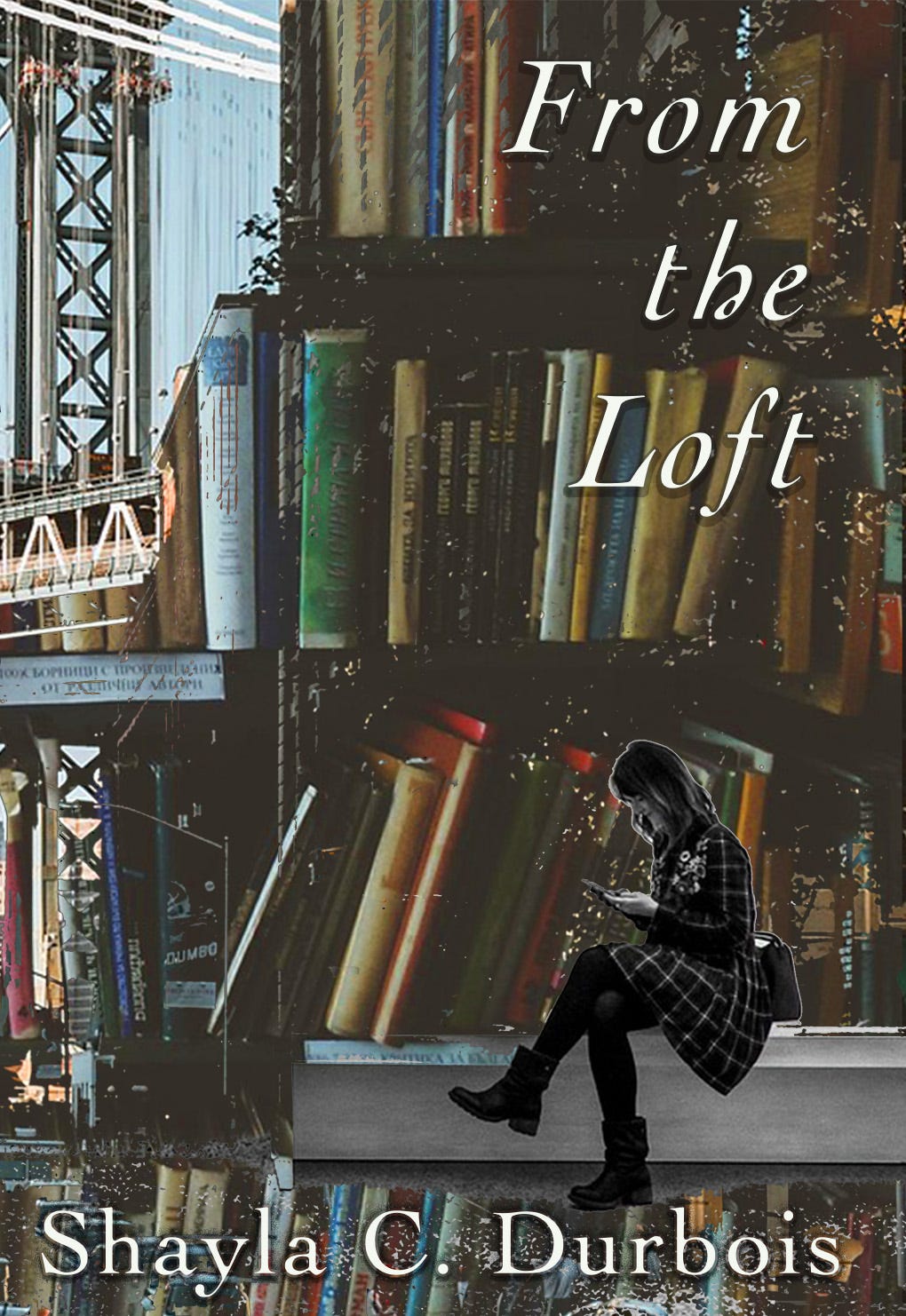
All of these concerns kept me facing inwards, unwilling to take my larger fictional creative labors and make them available to the public. I’m writing about this because I know I’m not alone in these concerns. But as I worked to polish up my novella, “From the Loft,” for public audiences, it finally came to me:
When I’m in the ground, the world is not going to know or care what I COULD have done.
Why not stretch myself to the full extent of my creativity? Why should I hold myself back just because I might make mistakes? I am a human, and I only get to live once. Posterity does not care about the shots I don’t take.
Posterity does not care about the shots we don’t take.
Why would we waste our lives keeping quiet, weekend hobbyists, keeping our fiction on private hard drives, where nobody can see our typos or accuse us of poorly constructed sentences, weak plots, and unengaging characters on Goodreads?
I am not advocating for half-baked story lines or atrocious spelling. But spellcheck exists, and Grammarly, and there are people out there who will read your work and give you feedback. I am advocating that we do the work, the hard labor of making our art excellent. And at some point, we have to let it go, knowing it is not everything we dreamed it would be, as J.R.R. Tolkien writes about in “Leaf by Niggle.” (←Click the link for a free PDF version of this beautiful short story.)

But if we never release our work into the world, we rob the world of enormous beauty. Stories the world needs. Can you imagine if Tolkien had never made his work available to the public audiences? Deep breaths; he did. Everything is okay. But what a travesty that would have been, and we would never have known.
I’ll leave you with this: resist the temptation to be overly harsh with yourself. Don’t let you’re your inner critic shut down your creativity. Work hard, do your best, catch all the typos you can, hold yourself to high artistic standards, and then, when you’re proud of it, release it to the world, and move on to the next project. (A HUGE Thank You to the individuals in my life who stepped up to read my work and catch all those pesky remaining typos. I owe you a very nice dinner.)
With that, I’m pleased to release to you, in published format: “From the Loft.” This book was originally published on the paid side of this Newsletter in 2021, and I’m thrilled to make it available to you, the public audience, on OCTOBER 28th, 2025. You can buy it in paperback or hardcover on Amazon. I hope you are blessed by this novella. This is the first physical copy of my work I have chosen to release. There is more coming, so stay tuned. Please do leave a review on Amazon or Goodreads. The only thing worse than a bad review: no review at all.
Art is made to be enjoyed by audiences.
Adventure Awaits
~S. C. Durbois
S. C. Durbois Newsletter
1st Saturday every month: a new original short story.
3rd Saturday every month: a writerly check-in with updates.
4th Saturday every month: a new original poem. Subscriber access only.