
Burn the Ships
The Voyage into Post-Production

Dear Reader,
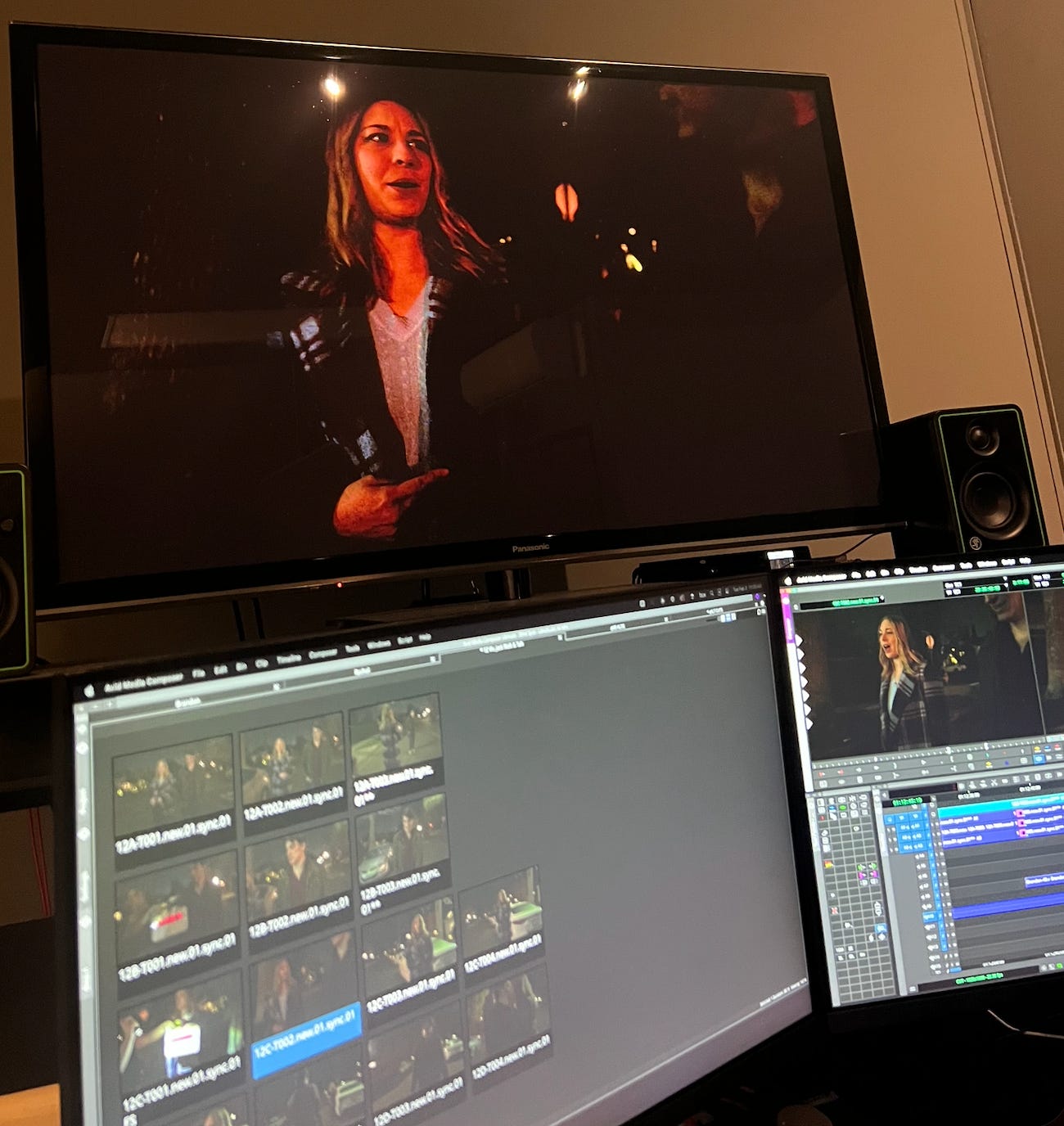
Yes, I am a day late sending you my check-in. It’s been a busy, busy week! On top of all the jobs, acting classes, book launch, and general life maintenance, I am sliding into the finish line on one of my short films. If you’ve been tracking my journey for a while, you know that in 2024, I set the overly ambitious goal to write, direct, and produce fourteen short films. In the end, I directed nine, in addition to helping produce five other projects.
Discerning readers will wonder: where are those short films, Shayla? Where can I watch them? Here is the status of all nine, plus a bonus project I directed and acted in this past November.
1. The Traveler: DOA.
This was my first stab at a script, a shot list, and a production schedule. I was my own production team, I shot on my iPad, and I am deeply grateful to my housemate for giving me one of her Saturdays to come act with me. Unfortunately, as this was my first attempt, it wasn’t very good, and shall remain unseen, “in the can.”
2. The Ghost of Electricity: COMPLETED
This world premiered at the Mystic Film Festival. You are welcome to watch it here!

3. Forget-Me-Not: COMPLETED
We are almost done with our festival run!
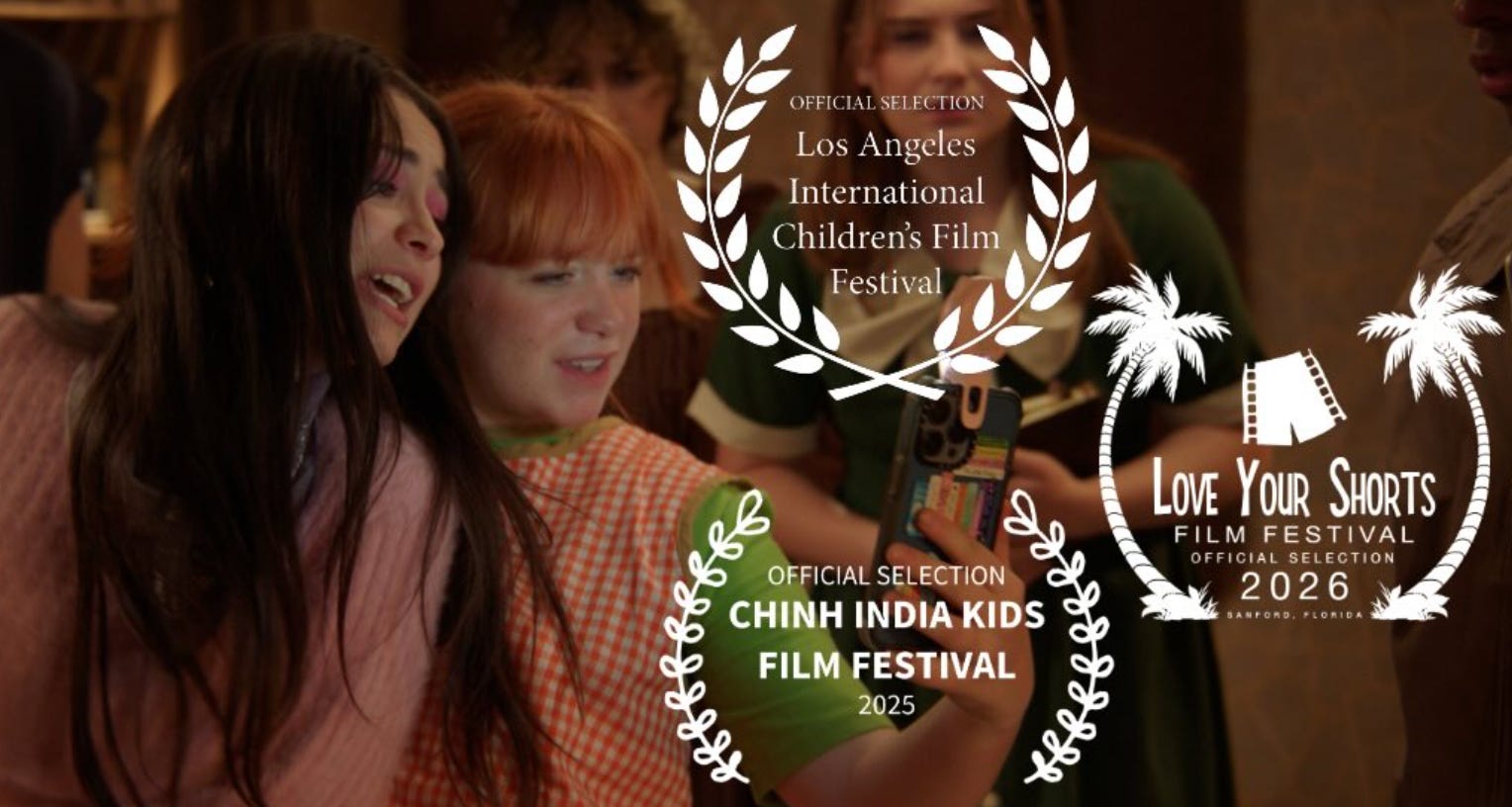
4. Roommate Generation: PRELIMINARY CUT
5. Echoic: POST-PRODUCTION
6. Shivved: POST-PRODUCTION
7. C’est La Vie: POST-PRODUCTION
8. Rebellex Predominus: POST-PRODUCTION
9. Blind Spot: FINISHING
10. The Hormone Games: POST-PRODUCTION
I cannot believe we are in 2026. These projects were shot over a year ago, so where are they? Why is it taking me so long to complete them?
BARRIERS & BUDGETING
PROBLEM #1: There are A LOT of projects. I felt a little bit like a squirrel in the middle of the road: Frozen by indecision. Which way do I go??? Traffic is coming!!!
PROBLEM #2: The finishing process takes money. You have to pay an editor to cut the footage together. Then you have to pay for color grading so the image's tone reflects the story being told. Then there is the sound finishing, and poor sound quality is a dead giveaway that a project is low-budget. Last, but most certainly not least, you have to pay a composer to design a score that accurately serves your narrative. The price tag on even one of these projects is more than an indie filmmaker can swing, and I had six of them.
I thus decided to edit these projects myself: it would be great training as a director! I’d learn more about composing a shot, the sequence of shots, guiding performance, designing transition moments, yadda yadda yadda. In a lunch meeting with a well-established editor, I was advised, “Yes, you should do one project so you gain the experience, but then get editors for the rest.”
I kept my poker face, knowing I did not have the finances to hire a real editor. This pushed me back to Problem #1: Which project to start with? Which invitably slammed me into…
PROBLEM #3: I have zero time to spare, and editing is a steep learning curve. Let me be very clear: I subscribe to the “figure it out” mentality. If I waited for people to do things for me, I wouldn’t get very far. This also tends to be a trap for most artists: We believe that because we CAN do it all, we SHOULD do it all. Why would I pay somebody to do something when I could conceivably figure it out myself?
About a year ago, I met a social media manager, and as I discussed the possibility of hiring her, I said, “I know I can do my own social media, but I just haven’t made the time for it.” She interrupted me and asked, “Is it that you haven’t made the time, or that you don’t have the time?” I almost cried. It was such a compassionate response, and I finally realized how much I was trying to accomplish on my own.
After a solid year with no progress on projects 4-9, and now project #10 in the can, I realized that the major hold up for these projects getting done … was ME. My insistence that I be the one to edit them. Why? Yes, the money was a part of it, but most important…
PROBLEM #4: I want these projects to be as good as they possibly can be.
Editors have tremendous power over a project. The way you cut a story together can make or break it. A story is written once by the editor, rewritten by the director and the actors, and rewritten the third time by the editor. I had poured too much into my babies to be okay with shipping them off to boarding school, where I had zero say in the kinds of adults they would turn into before presenting them to the wider world.
So I sat on these projects for a year. Was that year wasted? No, I don’t think so. 2024 was deeply intense and stressful. Did I love it? Yes. Am I made to direct? Yes. But in 2024, I went into survival mode. I was so nervous I couldn’t eat and dropped significant weight. I was sleep-directing and barely ever stopped to rest. And that was through March 2025, when we wrapped on Blind Spot. Suffice it to say… I needed to recover. I also believe the time away from these projects was helpful to me, because they became less “precious.”
I spent August through November rehearsing, prepping, and producing “The Hormone Games,” and when I finished that project, I looked back at the string of uncut footage and realized that I was the reason these were not completed.
I accepted defeat and investigated hiring editors. Through my network, I was put in contact with a well-established, well-credited editor, and when I explained my original desire to edit them all myself, she said, “Can I interrupt you? If you edit them yourself, you’re going to edit the movie you see in your head. If you bring in a skilled professional, they’re going to see things you don’t see. And then you can come alongside them and guide the project. Ultimately, between the two of you, it will be better.”
That’s really all I want. Even if I’m not the editor, I just want the story to be as good as it can be. It was such a relief to hear that hiring someone else was truly the best option for the projects.
The next question became: where am I going to get the money for this? After sitting on this question for a few days, it finally dawned on me (while blow-drying my hair) where the money was. I had earmarked a chunk of cash from my last bonus for living expenses, joyously thinking that I might go a year living in LA, not deep in debt. A little peek behind the curtain: all of my money goes to making these projects (all the money I have, and all the money I don’t have). This is very much a “burn the ship” mentality. There is no going back, no safety net. My entire paycheck from producing my first feature film went toward directing and producing “Blind Spot.” I put my money where my mouth is and just have faith that I will be taken care of. Miraculously, I have been. I thought year four out here might be different, but no. The challenge now is: seeing where the money is coming from, will I still bet it all on black? Yes. Yes I will.
Burn the ships.
I built a budget for each project's post-production. I designed this based on asking around for standard editor rates. Once I saw those numbers, I bumped up the budget based on what I felt I should pay for these projects. I’d rather pay the babysitter more to make sure she takes good care of the kid. I double-checked these rates with a longtime editor, who gave me the thumbs-up.
EDITING
Once these project prospects went out, editor emails came pouring in. This told me my rates were competitive, thank goodness. But I also learned that seeing so many projects all at once was a huge encouragement to the editor community, in an industry that has ground to a halt. This also meant I was talking with editors who had multi-decade careers. Frankly, building a body of work now, when there’s an industry full of professionals with no jobs to speak of, is hugely favorable to a filmmaker breaking in. In realty terms, it’s a buyer’s market.
I was honored that Jeff Granzow accepted the contract. I hired him to edit Blind Spot, and within three weeks, he delivered the first cut. We then met and, for four days straight, worked side by side to tweak and strengthen the cut. Jeff brought all of his hard-won strengths as an editor designing sequences that would have taken me ages to work out on my own. He was then hugely collaborative as I asked for changes and tried things.
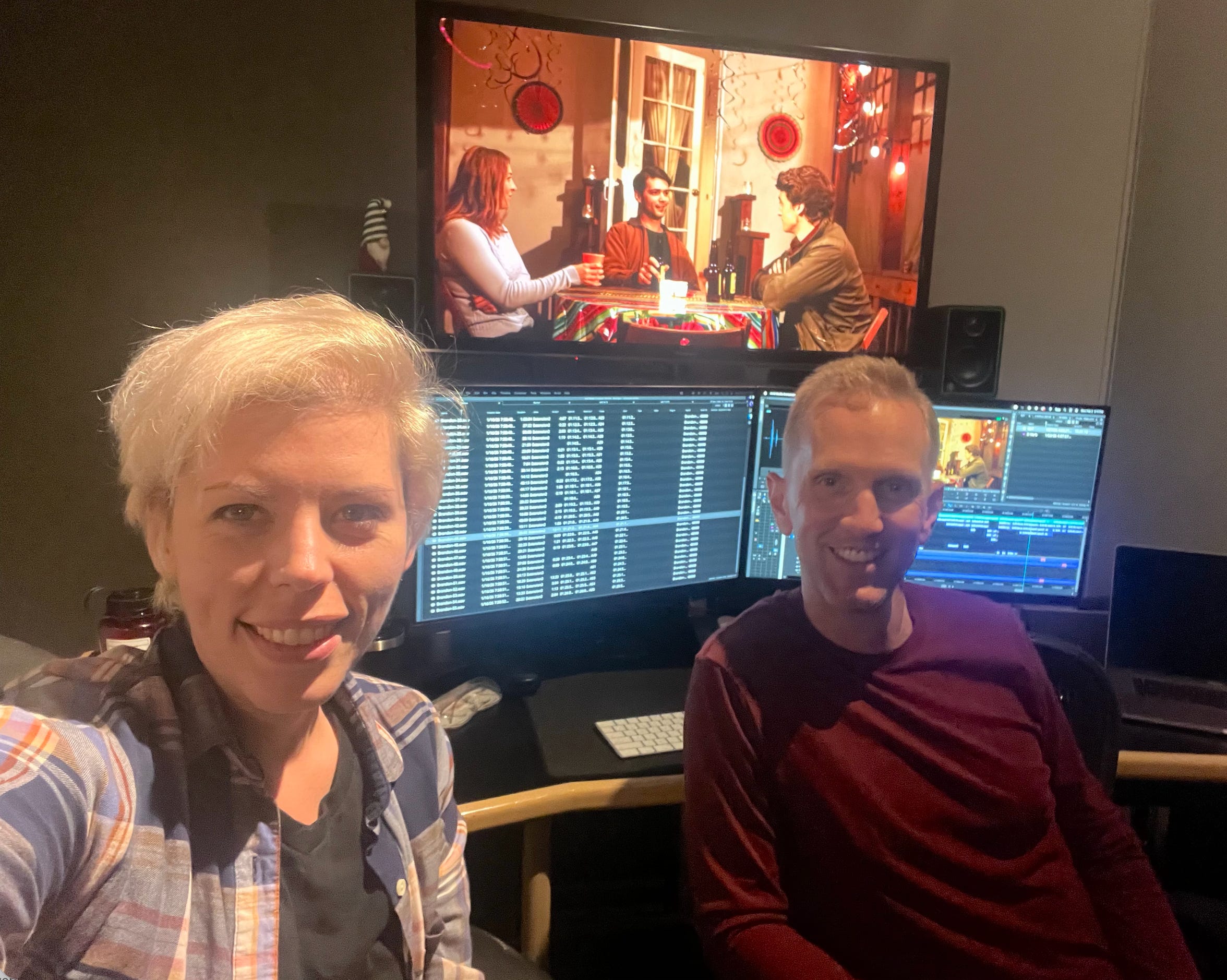
By the end of day three, I was very happy with our cut. I started investigating the rules and regulations of Cannes, which is my target festival for this project. We have to submit by March 1st, so we were coming into the end, but if the team kept a good pace, we would make it. And then I saw the regulation that all short films had to be under 15 minutes, including credits… we were at 15 minutes before credits.
I went home that night so discouraged. Was all that work for nothing? Everything on screen was vital. Had I really come all this way just to be foiled at the last minute? I lay in bed, unable to sleep, endlessly turning over where we could possibly trim footage, until a darker thought occurred to me: Was it even worth it to apply to Cannes? It is one of the most competitive festivals in the world, so would they even accept my short film? For those of you familiar with “The Hero’s Journey,” this was my “Dark Night of the Soul.”
Here’s the problem: Other people will disqualify us, and we have no real control over that. But we should never disqualify ourselves. Get yourself to the starting line, and let them reject you. But don’t rob yourself of a victory because YOU rejected you. To succeed, you do have to believe in yourself first and foremost. If you don’t, then how can anyone else? Besides, people want to back somebody who knows what they want and believes in themselves enough to chase it.
With that decided, I thought, “Ok, what if I just trim up every last little second we don’t absolutely need?” So at midnight, I got out of bed, pulled up the cut as it stood, and second by second, made a list of all the little micro-tweaks we could do. I added them up as we went, and once I reached 60 seconds, I just kept going, trying to buy myself as much margin as possible.
The next morning, Jeff and I went through my list. In two hours, we had it under 15 minutes… including credits. We watched it back, and frankly, the cut was even stronger. It sang, perfectly tuned. Just goes to show the power of the micro-change, very similar to Atomic Habits. This experience has caused me to wonder: what are the micro-tweaks in my own life that I could change that would ultimately make a big difference? What areas could I spend less money, or more intentionally spend? What thought patterns could I adjust towards life-giving thoughts? What conversations could I spend just a little more time and kindness on? It turns out it really does all count towards the final result of the end product.
We locked cut! And then…
FINISHING
Once a project is locked, it goes to three different departments:
COLOR, SOUND, & MUSIC
COLOR GRADING
The color of a picture is deeply powerful in communicating mood, setting, tone, atmosphere… so many things! One might think correcting the color of a picture is a simple matter. After all, we all know what colors look right, right?
Wrong.
The science behind color grading is actually deeply technical and subtle. I have attempted this a few times myself in the premier color-grading software, DaVinci, and I feel a bit like a toddler plunking away on “chopsticks” on a Steinway.
(Mommy! Daddy! Look at me, I’m doing it!!!)
With my respect for the science/art of color grading sufficiently established, I went to Kappa Studios for a “Color-Spotting” meeting with my colorist. This is a meeting between the director and the technician to guide the project's look and mood. I’ll not deny… I was nervous. Would I be able to articulate what I wanted to someone who definitely knew his business far better than I did?
It finally occurred to me: I am an artist. I have been drawing and painting since I was little. I have eight years of serious visual training, and I taught art for three years. This is one department I could not be better prepared for. So I sighed with relief and went to my color-spotting meeting.
To my immense relief and delight, my colorist, Toby, was an incredible host in his studio. He was warm, welcoming, and generous in articulating everything he knew about guiding the color of a project. He asked me what tone I was going for, and instead of telling him what hues or styles I was interested in, I confessed the areas I was most worried about, and my ultimate goal for this romantic picture. He smiled and pulled up a picture of a painting: “Luncheon of the Boating Party,” by Pierre-Auguste Renoir. He overlaid it on a scene from Blind Spot, rife with dramatic tension, in which everyone in the room wanted the attention of someone else. To my shock, the scenes overlaid perfectly.
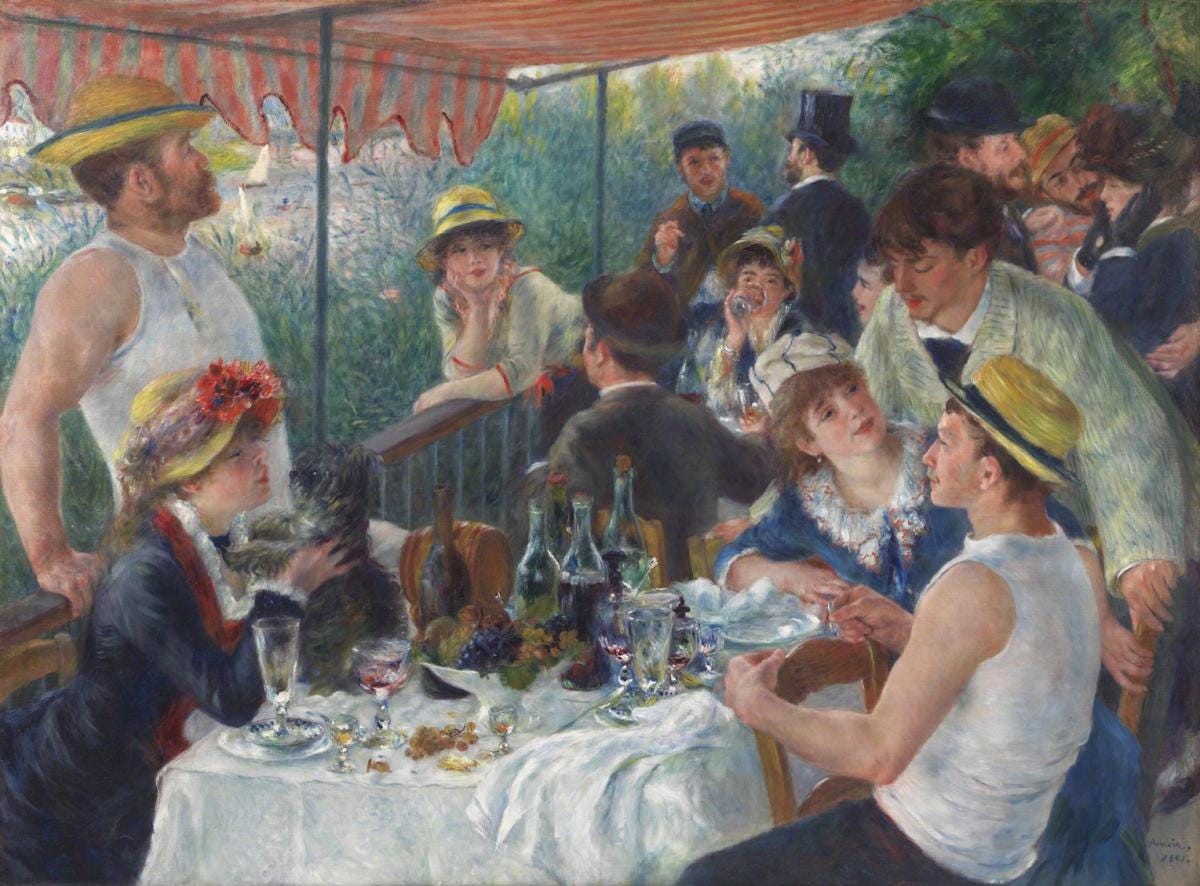
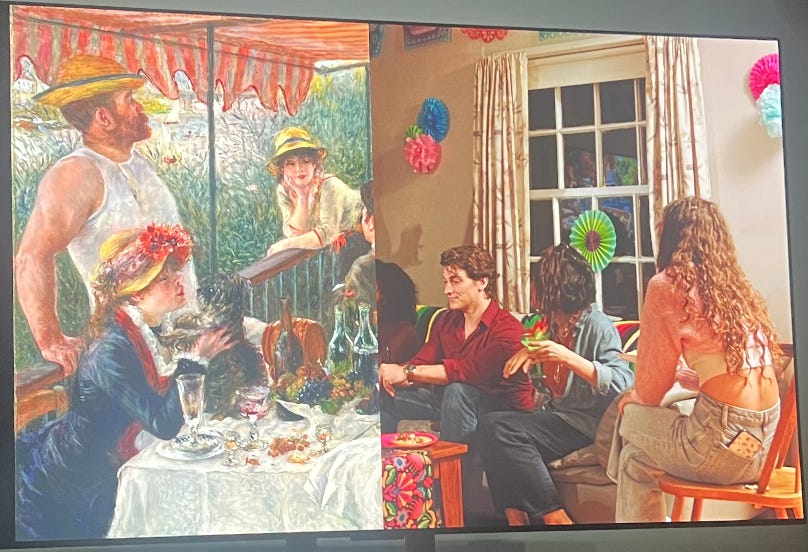
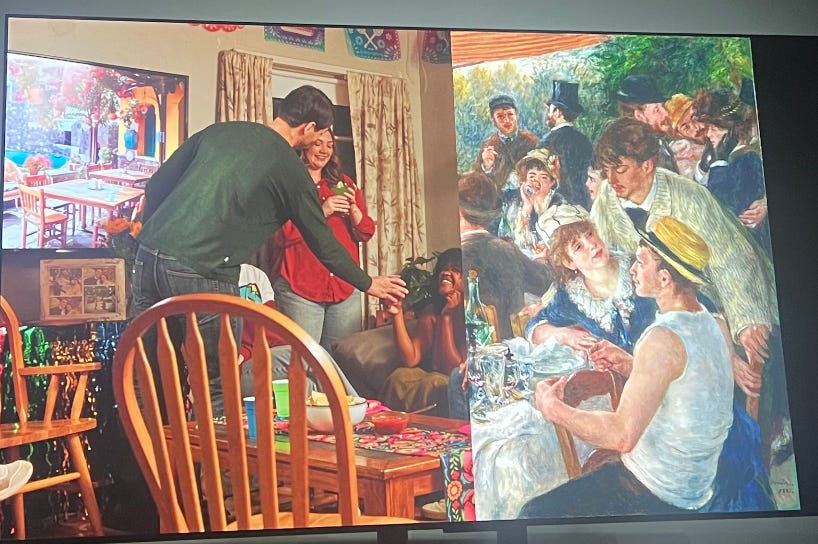
Toby pointed out how the same underlying colors were in both, and he began tweaking the metrics so that the mood in the room felt more like a busy house party for early 30-somethings. He was welcoming of my notes, and when I pointed out an adjustment I wanted, he (like a true artist) said, “It might not be that thing that’s bothering you, but everything around it.” He made a dramatic shift to everything else, and lo and behold, he was right, achieving exactly the effect I subconsciously was looking for.
He brought moonlight to an outdoor patio scene that was mostly browns and warm tones, and he brought out the light of a night sky that was previously pitch black. This is the benefit of working with professionals: They know how to use the tools to achieve exactly the effect you didn’t even know how to ask for. But finding a skilled technician who is also a joy to collaborate with is a rare gem.
SOUND MIXING
Kappa Studios is a Post-Production house in Burbank, and they are handling all color and sound finishing for Blind Spot. The sound mixer will look at all of the levels of various noises: dialogue, Foley (sounds from the material world), Walla (the background murmuring of a crowd), and score. The art of balancing the levels and weaving a narrative together through sounds is a complex craft. I admit, I have only rudimentary attempts at sound mixing under my belt, enough to know that those technicians earn every dollar of their paycheck.
Kappa Studios did the post-production on THE CHOSEN, HOUSE OF DAVID, THE WORST CHRISTMAS PAGENT EVER, and many other projects over the decades. They are a company of excellence, with a heart to serve the community of filmmakers who are creating content with values. Not only are their studios and facilities state-of-the-art, but I have been treated exceptionally well as a client, as it is clear to me that they treat all their collaborators. I am deeply honored to have the opportunity to work with them in these early years of my career, and I hope to work with them again in the future.
MUSIC
I am very thrilled to have long-time composer James Covell designing the music for Blind Spot. We had a temp track for the score in place, and James designed a soundtrack inspired by that. He built the score around classic Rom-Com, telling me that I reminded him of Nancy Meyers, a well-known Rom-Com director. Yeah… I’ll take that compliment.
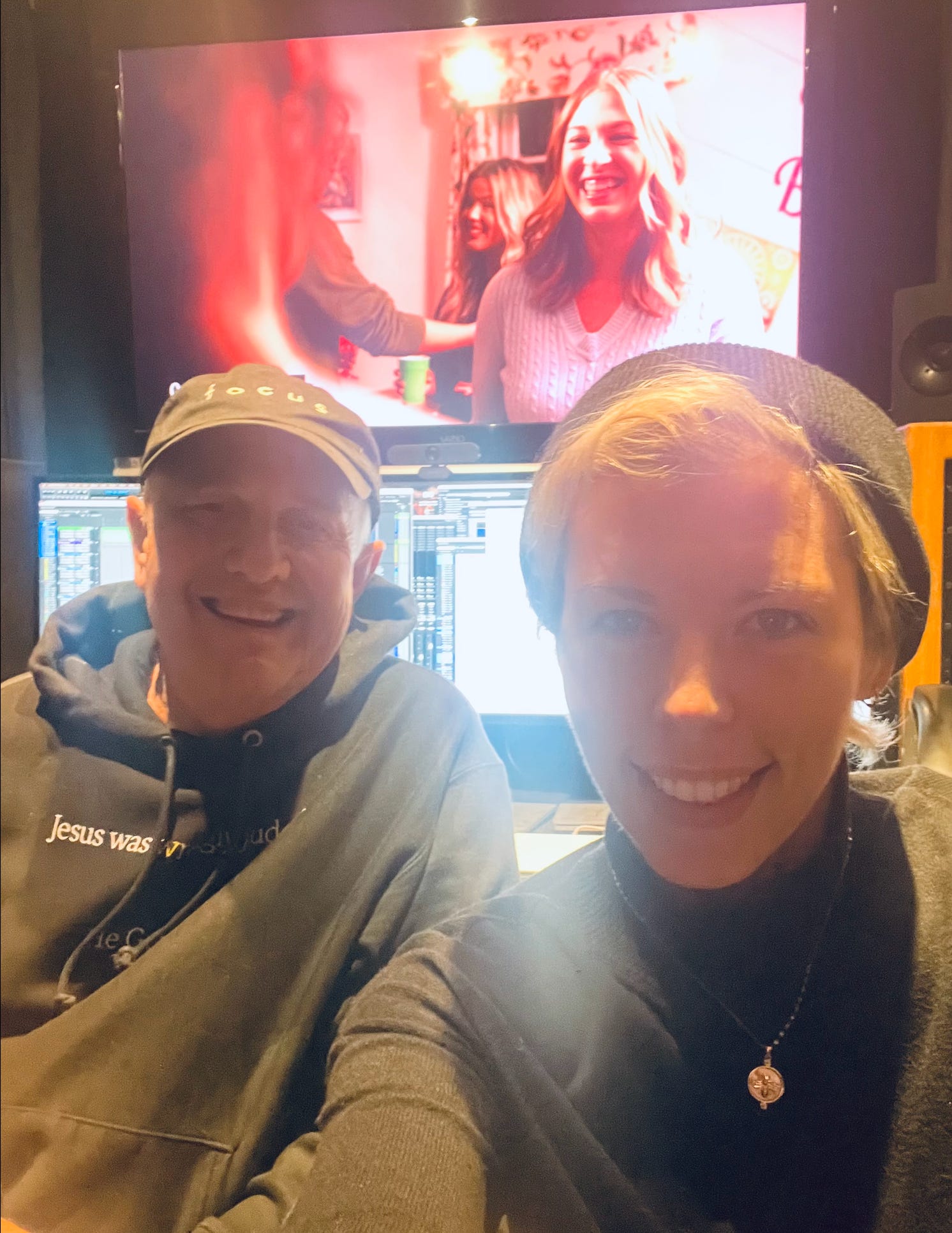
Watching the cut with the jazz and otherwise romantic music supporting it, which James designed specifically for this film, was like watching a pencil drawing come into full color. I realized for the first time just how romantic this story really is. My collaborators and I didn’t shy away from the sweetness of it, and I’m grateful to say every single person involved in the project was fully committed to the genre. I believe it’s that commitment which keeps the narrative from becoming cheesy or cliché. Instead, it’s a feel-good film that left the test audiences reminiscing on their own awkward romantic journeys.
This is the whole reason I made Blind Spot. Personally, it took me a long time to realizing that the awkward, desperate, lonely, and completely ridiculous narrative going on inside my head, wasn’t just happening for me, or women in general…it was happening for men too. The men I have shown the project to have said things to me like, “I had no idea girls thought that way.”
BINGO.
My goal with this piece is to help us all feel less alone, less afraid, and more united in the awkward adventure of trying to understand and connect with the opposite sex.
FESTIVALS
Blind Spot will be finished and submitted to Cannes by March 1st, 2026. I will then submit this project to many other festivals, hopefully one near you! I’ll announce in this newsletter and on social media where we are accepted.
BIRD BY BIRD
As Anne Lamott says, the only way to get a book written is word by word, bird by bird. Turns out, the same is true with finishing short films. Just pick one, and get it done.
Film by film.
Adventure Awaits,
S. C. Durbois Newsletter
1st Saturday every month: a new original short story.
3rd Saturday every month: a writerly check-in with updates.
4th Saturday every month: a new original poem. Subscriber access only.
I am shattered and spread out too thin. Why? Well, divorce is why. MY physical pain is too much for my now ex wife to handle. She can't deal with me not helping out as much as she wants. So much for vows...
Why am I telling YOU this?
Because I had to lean back to rest my neck and back as I'm trying to pack up my life and move out (she's keeping the house because our dogs can roam the big garden and the forest, and I'm too broken to walk them).
While resting my body a bit, I saw this text. And it was so interesting that I just HAD to read it all! I can't wait to... uhh... watch your shorts? Watch your shorties? Watch your short movies! English isn't my first language so I really don't know how to explain that... but "watch your shorts" might be... suggestive. Suggesting? Bah! Might make you think I'm staring at your shorts and not your short movies.
Also... My last boss (most recent boss?)... is actually going to be my last boss as I can no longer work, because of the injury from a hit'n run. And she said that I tend to over explain. Yeah, I know! Because I want people to know the reason why things are... the way things are.
And... Yeah, she was right. Is right. The part about you having to cut the story down to 15 minutes made me nod. I sat here, actually nodding like a fool, and the dogs glanced at me before drifting off to sleep again. Had I also said something out loud that woke them up? Maybe. Or I chuckled.
Uhh... I digress. I do that. Sometimes. That's something YOU can't do when you tell a story, especially not in a movie.
So... Yeah. As I said earlier *waves upwards on the page*, I like the way you write and describe things. Or maybe I didn't say that? Well, I did now! I will watch your... uhm... Shorts, with interest and anticipation!
Just one last thing; where can we watch them when they are done?
Sorry for the long text. Uhh... I need to learn how to cut things short! Cut shorts? Shorten things? Be.shorter! And again; thank you!
/a neverending guy from Sweden (not that you asked. Or needed to know, but there it is, anyways.)